The Witcher 3 is a good game, but I’ve got a lot of problems with it. People sometimes say it’s one of the best games ever. I very much disagree, I don’t think it’s one of the all time greats, I hated the combat, I think the open world is very repetitive and filled with content, but not much substance. I really think the skills are pointless, the mutagens don’t do anything, the weapons in the game are trivialized by the combat system and armor is really just for style. But the story, the dialogue, the characters, the writing and the visuals in the game, are all so good, that they cover up a lot of the games deficiencies and make people misty eyed when talking about this game. All of this is to say that Blood of Dawnwalker, which is a chip off the Witcher block, actively does try to assuage most of my qualms with the Witcher 3 for sometimes better, sometimes worse. Now onto the stats:
Total Playtime: 53 Hours 0 Minutes 3 Seconds
Total Number of Sessions*: 68 Sessions
Total Number of Crashes: 41 Crashes; 21 crashes pre Patch 1.0.5; 20 crashes Post Patch 1.0.5
Longest Session: Session 1
Longest Session Playtime: 2 Hours 57 Minutes 7 Seconds
Playthrough Start Date: Mon, Sep 7, 2026
Playthrough End Date: Sun, Sep 20, 2026
* Remember a session is anytime I start a game to the time I close it.
To best approach Blood of Dawnwalker, I think it’s critical to sort of understand the conditions it arose from. The studio behind it, Rebel Wolves, is made up of individuals most of whom worked on the Witcher 3, which is why I mentioned it earlier. This game is a product of the covid era spending boom by a ton of companies, Rebel Wolves was started in 2022 and secured funding from Netease to essentially make Blood of Dawnwalker. But unlike most of those other games with a similar path, this game actually got made.
The point is, this game is made by people who knew what they wanted to make and knew how to do it.

I’ll start out by saying I really enjoy this game, It’s one of my few week 1 purchases of a new game in a while. I’ll be honest, I’m not that attracted to a lot of new releases, because if they don’t offer me something that I don’t find interesting or exciting, I’m not gonna bother spending money on a game that I don’t even want to play. The game list I have is already extremely long, Metro: Exodus, Killzone 2 & 3, Transformers: War & Fall for Cybertron, Dishonored, Dishonored 2, Death of the Outsider, The Thief series, The Deus Ex series, I’m sitting on a lot of the older DND games too, Baldurs Gate 1, 2, Icewind Dale, Neverwinter Nights, Max Payne 3, and the list goes on. Point being, I don’t need to play newer games, I’ve got enough already, so when a new game comes along that I want to play, it really has to capture my attention.
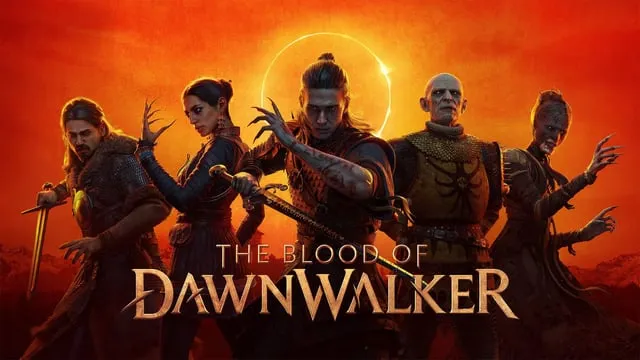
What I’d mention first and foremost is that Blood of Dawnwalker has a great hook, which is that you play as a guy in medieval times who is a human by day, vampire by night. And you emabrk on a quest to save your home somewhere in Eastern Europe from the vampires who have killed the monarchy and assumed power. All while racing against time to save your family from being killed by the aforementioned vampires. The Witcher 3 influences are also pretty clear with how the game treats it’s title character, the Dawnwalker, Coen of Laslea. But in my opinion this game is not just Witcher 3, but you’re a vampire, there’s a lot more to it than that. Now instead of breaking down the game into it’s different systems, I think it’s probably better to just work through what I love, what I like and what I hate about this game.
So what is to love about Blood of Dawnwalker? Luckily, this game’s pretty damn good, so a lot! First let’s talk about the most “controversial” mechanic in this game, the time system, because unlike some people I think it’s a really great system. In Blood of Dawnwalker, you are constantly reminded that you are running out of time, your family is going to be killed after 30 in-game days and it’s up to you to figure how exactly to save them before time expires. To do this, you accomplish quests and other activities around the game world to get experience, skill points, equipment and unlock new quests that all aid in growing your character and progressing the story. These however come at a cost of time, you only have 16 time units a day, split half and half between day and night. Some activities and quests are locked until it’s day or night, so it’s up to you to figure out how to spend your time wisely to get the most out of each day. The reason why people find this system problematic is that it imposes an artificial constraint on their time in the game world, that they can’t experience all of the quests, or do everything they want to do. They believe that this system hurts the game because it naturally limits the player and what they’re able to accomplish, and works against that RPG philosophy of “Go Anywhere, Do Anything.”
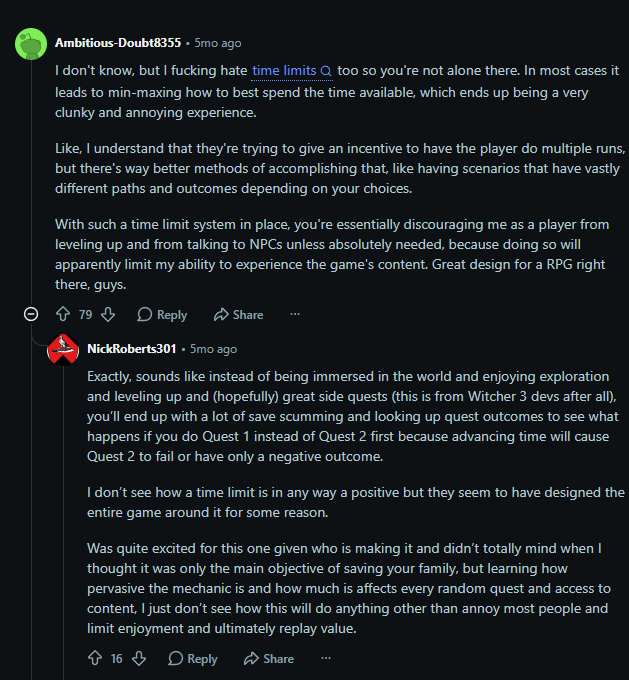
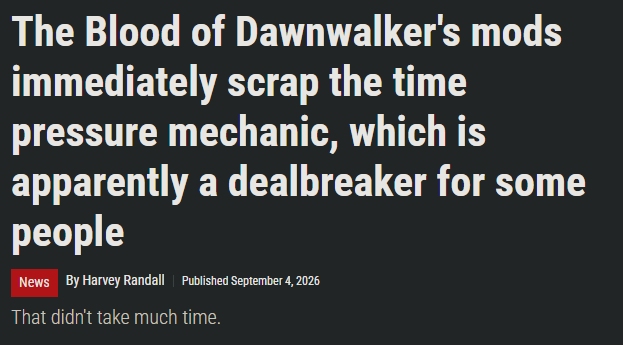
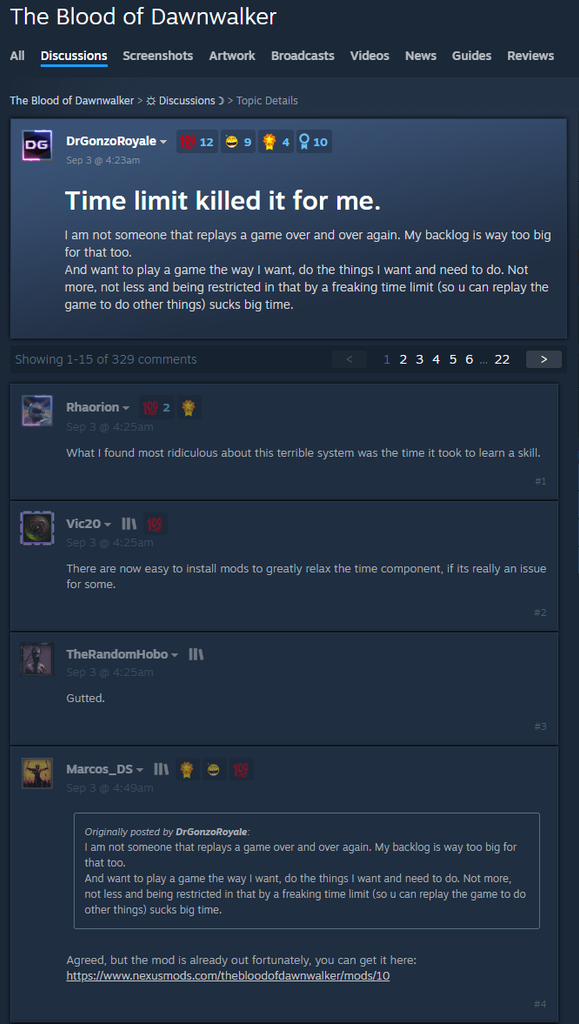
I’ll be frank, this is a shortsighted, ignorant argument. Let me start out my rebuttal to this by saying, that there’s no way and I MEAN no way, that most individuals when they sit down to play an RPG, play through all of the side quests, all of the activities, all of the POI’s and all of the content in the game. Nor do I think even dedicated players, who invest a ton of time into RPG’s, and then replay them, see and experience all of the content. I know, because on my last playthrough of Witcher 3, (which I stopped playing because I tried to do all of the POI’s on every map, that and the remastered version and the DLC were announced). I had to stop at the Skellige map, because it’s truly awful. It’s bad, very bad, so very bad. The map is littered with the exact same content. Not to say that there isn’t some cool things you find as you go across the game world, but holy shit. If I ever see a bundle of barrels floating in the ocean again. I will drown myself. And there’s no way, that most people who went through Witcher 3, invested the time, sanity and effort to even go through 1/3 of the POI’s on that map. There’s simply so much shit and a lot of it is just recycled content, as is the case with pretty much every other modern open world RPG.
And guess what? You’re not supposed to, the developers did not intend for people to sit down and work their way around the map doing every single POI and activity, they are distractions while you’re doing other quests and you just happen to be near this other thing. So hey, what the hell, why not go check out that POI at that lake, tower, or fortress, it’s not far off from where you need to go. So when I see people complain about not being able to do everything in an RPG, I can’t help but chuckle, because you’re not intended to and I know they don’t. But ultimately, this entire argument is pointless and doesn’t matter, because all of this “controversy” was started before the game even came out and people got their hands on it. So while I’m not trying to bash a consumers right to criticize the potential implementation of a mechanic in a game, I am criticizing the repeated whining by gamers about games that haven’t even come out yet. It’s stupid, stop it.
Back on topic though, the time mechanic, yes, it is an artificial constraint, but in my opinion, it’s an empowering constraint. The time system is not just worked into activities, it’s also worked into your skill tree. So you’re not just spending skill points to upgrade you’re character, you’re also spending you’re time. It’s worked into the main quest line at various stages, and it’s worked into the gameplay with the day and night mechanic. This forces the player to consider their actions extra carefully, the more mundane aspects of the gameplay, investing into your skill tree, doing side activities, exploring the world. Now, they are all critical in determining the final outcome of the game, as they each take bits and pieces from the finite time you have in the game world. It even works into the dialogue and how you interact with characters. There’s an interaction you have with your siblings early in the game’s tutorial where you are taking them to go fish by the river, on the way your younger siblings stop because their feet hurt and they’re bored. You get an option to play a game with them to encourage them, but it costs 1 unit of your time, or you can essentially tell them to suck it up. In pretty much every RPG, I’d be the nice guy and play the game with them, but in this I told them to get their act together because I didn’t want to spend time in this activity. I wanted to save it for later. And that same pressure pressure is put on you at various stages of the game, you fell inherently constrained on time which subtly affects how you interact with the NPC’s in the game. Point is, this system doesn’t just affect the gameplay with the transformation between vampire and human, it also alters how you interact with the story, characters and how you individually, spend your time playing the game, every single session.
This same philosophy does carry on through the game, where your behavior playing your character might change because you are constrained on time. It works very well in challenging the player to consider their actions and to push them to get stronger before it’s all over. And let me just say, there is more than enough time, I could’ve ended the game with about 8 days left to go and I just chose to keep playing and seeing more of the world, doing more activities, etc. You could even end the game on the first day if you know where to go and what you’re doing. The time mechanic is not a threat to the player’s enjoyment, it’s a good push in the back to keep them moving forward and staying on task. A real issue in a lot of other Open World RPG’s, which allow the player to get bogged down doing menial things, when they could be enjoying other aspects of the game. But they don’t have much recourse to get the player back on task besides giving the player good loot, unlocking new abilities, seeing new story content, etc. The time system does a great job at making the player’s actions and choices more meaningful. I do think it could do with some tuning, the game does a good job at being up front with you about what activities and choices cost time and how much. The game also has visual effects for when you’re about to preform an activity that will cost time. But there are some activities that don’t feel fair in the time that it costs. Such as restoring fast travel shrines, each costs 1 unit of time, but many of them require you to clear out a camp of bandits or soldiers. These also cost 1 hour to clear these camps out. I think my recommendation here would be to keep these linked activities in the game, just make all the costs up front as opposed to spreading them out and kind of baiting and switching the player. There are also quests that require you to start the quest line or sequence at a specific point in the day. But the game doesn’t tell you this whatsoever, you’re left to infer this from what characters say before you’re given the option, these kinds of choices and activities need to notify you before that, a lot more explicitly.
The next thing I love about this game is the narrative, while I don’t think it’s an inventive narrative or is absolutely amazing. What I love about the narrative is the amount of freedom it gives the player to alter it. The ending of the game can play out in a few ways. But there are alterations you can make to the narrative that don’t just affect the ending but also different narrative points leading up to the ending.
The setup for the game is that it takes place during the Dark Ages at the peak of the black plague. In Vale Sangora, a fictional kingdom set in the Carpathian Mountians in Eastern Europe, the Kynaz Dragosti Skendor is a ruthless tyrant who is seeking to crush the Black Plague by burning it out and killing any carriers. During one of his purges, he is killed by a group of vampires, or vrakhiri, headed by Brencis. The other Vrakihiri are Xanthe, Bakir and Ambrus. The group takes control of the kingdom swiftly while it is in turmoil and promises it’s peasantry that they will abolish all taxes, get rid of the ruling class living off their labor and cure the kingdom of the plague by allowing the peasantry to drink the vrakhiri’s blood. In return the valley must give up all ties to any religion, in Vale Sangora that is primarily christianity, and all adults must give a quart of their blood every few weeks at “Blood Masses.”
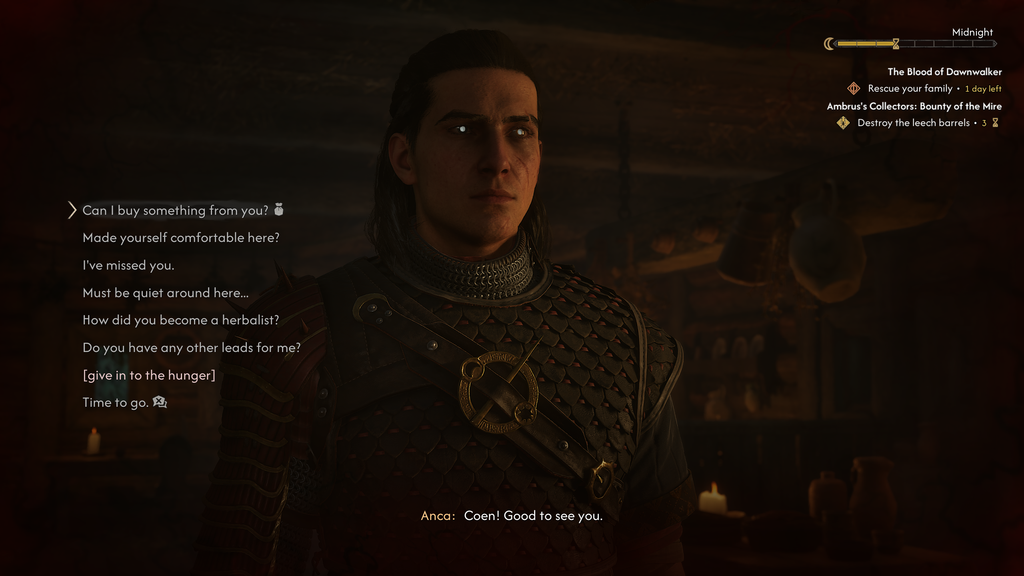
I won’t spoil too much more, including how Coen is turned into the Dawnwalker, however I will say that your family does get captured by Brencis to be killed for his Coronation in 30 days and it’s up to you to save them before then. A highlight I wasn’t expecting from this game was really liking the main character, Coen. I really enjoyed how his character was written and the different ways you could play Coen, whether or not to be a kind hearted hero or to fully become the blood thirsty monster that you are. He’s a fun guy and though he doesn’t have the masculine physical nature of a Geralt of Rivia, he has his own laid back and gentler way of interacting with others. The English VA, Will de Renzy-Martin does a great job at performing this upstart young vampire.
Another great thing I love about this game’s narrative is the characters, I don’t think any character that is formally introduced is under utilized, each character whether they are important or just in a single side quest feels unique, well established and makes the most of their role in the story. The relationships between Coen and the other characters feels believable and each has their own twist, with you being presented with a certain view of a character initially and as you spend more time with them, engaging in dialogue with them, or doing side quests for them. You begin to see a completely different side to the same character, this will lead to some fun interactions, but also contributes to another core design philosophy that makes me really love this game.
Which is that this game respects your time. I find that many games today just don’t do this. Either because they want you to keep playing the game for longer periods of times. Or they want you to spend more money in the game in order to progress faster. Many games as a result will not respect the time you spend. And irrespective of the amount of time you invest, will place artificial constraints to block you from progressing too far, too quickly. Why I play a lot of older games is because they don’t do any of that, the games aren’t that long, but they are filled with sequences and moments that test your skills or your critical thinking. These games were meant to be challenging, and the intention was for you to get the game, play it over the course of multiple sessions aim for that 10 hours of playtime mark and then hopefully, if you liked the game enough, replay it, get new character skins, take on challenges, etc. But your time investment isn’t all that unreasonable. And even taking my time with Blood of Dawnwalker, I still managed to beat it within 50 hours. Half of the time or even a third of the time I would’ve spent in other RPG’s like Cyberpunk, Witcher 3, Rogue Trader, etc. I’d have no qualms about playing this game again because I know that my time investment in the game will be worth it, because I actually enjoyed the game and also it’s not that long of an investment. 50 hours is a lot but it’s a lot more reasonable than say 100 or 130.
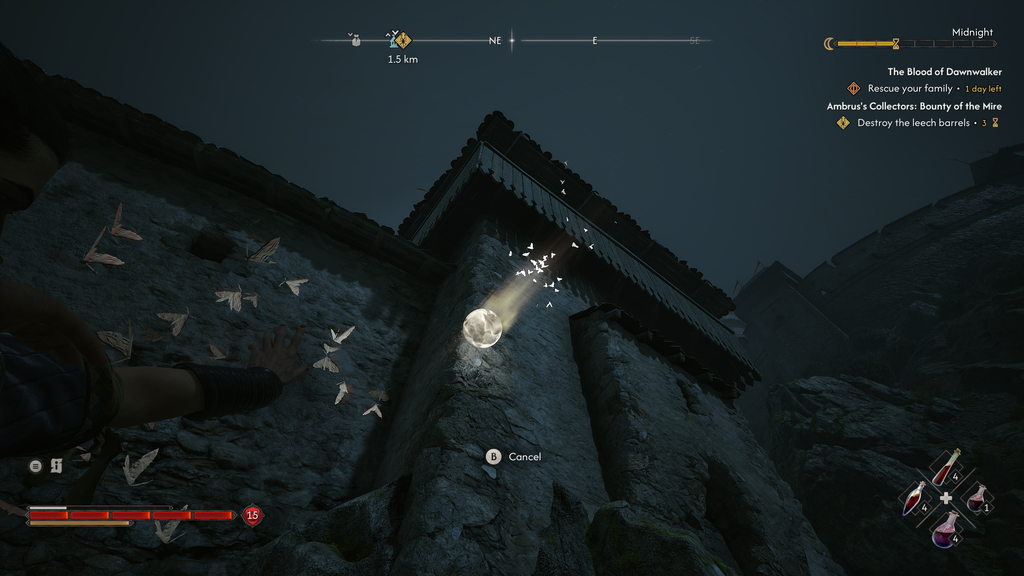
Finally, my sneakiest favorite part about this game is it’s movement system and I know it’s somewhat odd for me to say this. Most open world games like this, have very animation heavy movement systems and thus can be a little cumbersome and unenjoyable to control moment to moment. But I think Blood of the Dawnwalker has something really interesting in it’s movement system, which hopefully I can do justice. There are no horses in this game, so exploring the world is entirely done by running around it. However, you can gain skills that will enable you to have a haste ability. In daytime, you can press the sprint button again while sprinting, and you will slow down time and increase your running speed. I really like this because by slowing down time when you come across enemies in the open world, they will not immediately react to you since the time scale is slowed, so it allows a quick moment to consider whether or not you actually want to engage in these fights. And the system is thankfully automated enough so that when you come across obstacles that you would normally have to press another button to jump over or vault up, in this, it will just automatically vault, no additional button press necessary. At nighttime once you reach a high enough vampiric level, you are given the ability to shapeshift. You turn into a wolf, and besides that it pretty much works the the same as haste with slight differences while in the wolf state your jumping is enhanced and you don’t slow down time.
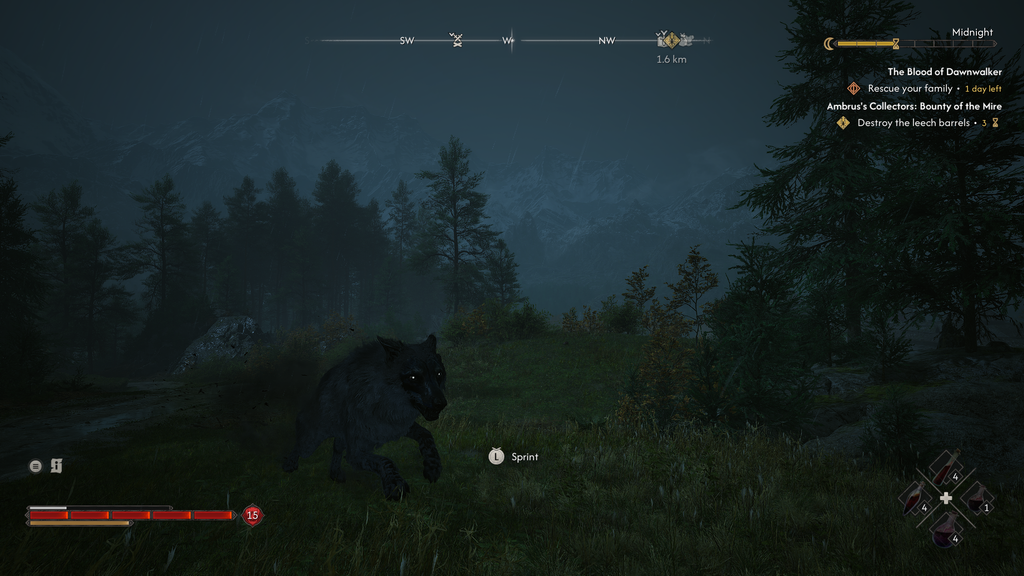
The more interesting movement mechanics come with the vampiric abilities, as a vampire you are given the ability to teleport short distances in combat, this just allows you to instantly get behind an enemy at the cost of some stamina. While not in combat, you can press the teleport button and that make you jump to a point in the direction you’re moving. Or if you hold down the teleport button you can actually aim and choose the location to teleport, within a given range of course. The other notable mechanic here is the ability to plane shift which simply means that you can walk on walls and ceilings, it takes stamina to do, though you can upgrade this to not use any stamina at all. But asides from select spaces in the game, for instance any building interior. You can plane shift anywhere and just start walking up the walls of buildings, mountains, etc. It’s very interesting, and unfortunately not used to the fullest of it’s potential. But combining these different abilities makes for very satisfying movement. This system really shines in the only urban space in the game, Svartrau the capital city. You can jump from rooftop to rooftop, by teleporting, and just pressing the teleport button actually does a really good job of knowing where you want to go without actually holding down and selecting the location. Or you can turn into a wolf, leap across buildings. De-shift back into a vampire mid-air, hold down the teleport button, select a location on a building’s wall. So that you are now plane shifting right above a guard while he’s walking his patrol and then use your sneak attack to drain him of all of his blood. Before teleporting back up the building, to the roof ,to stalk the city for other easy prey.
This movement system is really enjoyable, and I found it very satisfying to use throughout the entire game, the city is very well designed so as to give you your own pathways on the rooftops allowing for the city’s design to not feel contrived for you to move specifically this way. This isn’t a spider man or batman game where there are specific locations for you to move to and hang from so that you can sneak attack guards in a confined space. The world is open and their are no contrived locations for your character to move to or from. The entire city, every building, every rooftop, every surface is a place where you can move and use to your own ends. My only wish is that there were more locations like Svartrau that you could move like this in. It doesn’t even have to be a city. Maybe a large camp, a fortress or a large underground cave that you can move around in and clear out monsters or soldiers from. And I wish that this game had a proper stealth system for you to use so you can feel like this hunter stalking the night. The movement of this game is too good for this system just to be used to traverse the world, If another game is in the works I pray that more time and effort goes into integrating the movement mechanics into other systems. And expanding the movement system too, like running on walls and flying short distances. I think this expansion of the movement system is what I want most in a second Dawnwalker game.
Onto the things I just like about this game are it’s combat and open world, which to me are a little underdeveloped and utilized. As I said before, I abhor Witcher 3’s combat, It’s awful and I despise it so much that It actively prevents me from enjoying that game. Contrast that with Blood of Dawnwalker’s combat, and this game’s combat is by far, head and shoulders, altogether, 100x more enjoyable than Witcher 3’s.
The combat system is a directional melee system that people who have played Mount and Blade or Kingdom Come: Deliverance would be familiar with. You choose a cardinal direction to attack from and when an enemy tries to attack you, you choose a cardinal direction to block their attack. If you block correctly at the right time you’ll get a perfect block that will actually give you stamina back, so that you can start wailing on your enemies again. You also have skills that you can unlock by first finding skill books, these will allow you to upgrade your current skills or obtain new skills, all at the cost of time. The skill books are gained by doing specific activities in the game world, or killing guards. But the issue is that the skills aren’t all that interesting, some are just buffs you can give your character after some trigger. For example, this one vampire passive will have a chance to heal you after perfectly blocking an enemy’s attack. Other skills either fall into crowd control abilities, high damage single target abilities, DOT abilities, or stuns. It’s a decent system that I don’t think is used to the fullest of it’s potential due to a few key factors. Primarily, the enemy variety is very minimal, once you get about 5-10 hours into the game, besides bosses, you’ve pretty much seen all of the different enemy types and more importantly, their attack patterns. The enemy’s limited attack patterns are probably the most disappointing aspect of the combat system. They are all pretty basic and I can only think of one occasion when they add a new attack pattern to the basic human characters, causing them to sometimes feint their initial attack, before striking in a completely different direction. If there were some more attack patterns, more unblockable attacks that forced you to dodge them or are just very difficult to block, but easy to dodge. Or there were just tougher enemies that couldn’t be parried until you parry enough of their attacks in a specific combo. I think that would drastically improve the combat experience. Which leads to another major issue with the combat which is that there are no enemies that are completely ranged, every enemy is melee focused with maybe one ranged attack. Ranged enemies could have added an extra bit of strategy and when approaching enemy camps, or moving around Svartrau and more importantly target prioritization in combat. Altogether, unlike the Witcher 3 this combat experience works and is fun, so while it can definitely be improved, I think it’s a serviceable system for this kind of RPG.

Now to the open world, I have a systemic issue with open world games. I think modern RPG’s scopes are really bloated and I believe developers whenever they make a map for their RPG, try to block out and fill the world with as much content as possible. Little things that show up on the map that capture the players attention and get’s them off the beaten path. I have major issues with this kind of design philosophy enough to warrant a whole other post being made, suffice to say I’ll keep my qualms with this open world in particular, brief. What I enjoy most in RPG’s is not the gameplay, not the story, but exploration. I love wandering and finding cool things that were kind of, sort of, meant to be found. Not the big markers on the map that lead you to the same type of content and experience you could find at least a dozen other times in the game. But the stuff that isn’t marked that you just happen to stumble upon while exploring. Too often in these games do I look to the map to find secrets or plan my exploration through the world. Too often do I find myself while playing another open world RPG’s, scouring the map, hitting all the fast travel markers and all the other markers on the map. These games tend to become chores for players who are exploration minded, because if you put a marker on the map you’re telling me to come look at this thing, it’s important. Case in point (and I’ll try not to spoil too much here), there’s a fast travel marker on this section of the map that’s near this tower, so I decide why not go check out this tower and hit the fast travel point. So I get to the tower and unlock the fast travel point, I see a bear near this cave entrance and I think “Ahh this must lead me to the tower or something,” so I kill the bear and sure enough it takes me to the base of the tower, moving up through the tower I begin to understand that this is a sort of dungeon, that’s then capped off with a cool quest that then has actual consequences later in the story. This moment was actually pretty cool, because my expectations were subverted. I had thought that the tower was going to contain an NPC that would have some quest or have more relevance later in the story. Or that it would be another bandit camp for me to clear out. Instead, it was a dungeon with actual narrative consequences and a very interesting questline attached. However, from that experience, I discovered that there were more things like this and as I combed the world for more of those experiences, that sense of wonder began to fade. I began to see the pattern in the design. As a result of that experience with the tower, I understood how and why the map was laid out the way it was and used it to try and find these interesting experiences the developers were hiding. I’m not trying to say that these things were badly designed or questioning the quality of the content. It is all very well done. I’m simply stating that the systemic issues with Maps, mini-maps, markers, etc. Is that these elements are crutches for a larger problem, which is that the maps are too complicated and large for players to understand, the geometry is too hard to navigate, that it isn’t clear to players when there is a side quest nearby. Or where to go for a main quest. The game has to create these contrivances, the markers, a large map with actively updating ui elements, a compass, etc. Because without them players would get frustrated and have no idea where to go and what to do.
The best experiences I had in this game, were coming across something interesting, that wasn’t on the map at all. I just tracked it down all on my own. The sense of accomplishment is so much more heightened, when the design crutches are taken away and you can fully own that sense of discovery and wonder. Again, not to say that I think this game’s open world is poorly designed, it just suffers the same systemic issues as any open world RPG game, only doing some things mildly better.
Now onto the things I hate about this game.
While I wouldn’t say I hate the music in this game, it’s not like I thought it was tonally off or insufficient, I would say that it just doesn’t really stand out at all. The soundtrack is a lot more subdued and ambient. Which is fine, but when the action kicks up or there’s a dramatic scene, the music is not as present as you would maybe like it to be. This is one of the things that Witcher 3 did really well, not just because they had one of the best composers in the industry with P.T. Adamczyk. But that they also called his number in these kinds of moments, some of the best moments and cutscenes in Witcher 3 all have a killer track playing in the background. I think this game could really have benefitted from things like that. Music is an incredibly important part of any game, but in RPG’s it’s often used to set the tone of a scene, or an area, or to hint at the thematic elements of a story or a character. In short, it is there to enhance the experience. And I just wish that that element of the game was a lot better or more featured, because if it was, this game would be all the better for it.
The other thing I hate about this game is, as you can probably guess from my newly added statistic which is the crashes. For a large portion of this game, even after some patches, the game was very unstable. You can also see this through my statistics, you know how degenerate I can be with these games and play for extremely long sessions. But the longest session I had in this? It only lasted for about 3 hours, which as you also can see was the first session. Is this coincidental? No, probably not, they also featured the tutorial/prologue session at Gamescom, so it’s more likely this section of the game was far more polished before being featured and played at a Gamescom booth. Which I venture to guess just means that a majority of the game is unstable and undertested. I do not know the exact reasoning as to why the game crashes a lot, as I did not do any in depth testing to try and guess. Nor, have I read up on any of the conversations surrounding the games unstable-ness, so I don’t know any conclusions others have come to. I can only highlight that while the game is not stable, it is performant, over the course of playing I did not have any significant issues with the actual performance of the game. It kept a consistent frame rate throughout the experience, only dropping slightly in certain areas loading in assets. I messed around initially with the upscaler settings because it absolutely destroyed the shadows and anti-aliasing on lower settings. But that was about the extent of my fiddling with the graphical settings in this game. Regardless, the main issue here is that the game crashing 40+ times, over the course of 50 hours is not good, that’s a crash, under every 2 hours. That is also very not good in an RPG that is designed to value the time spent playing. I will note on this front however that they have made improvements in this aspect as time has gone along. With hope they can severely mitigate the frequency and consistency of the crashes in this, but still it is never good when the game experience is ruined by crashing.
With all that said, I think what I appreciated most about this game is how they managed to make this interesting new world, characters, story, etc. And on top of that they combined these interesting mechanics into an open world RPG. It’s not that anything here is necessarily original or new, but that this configuration of things hasn’t really been tried yet. I love that, just for the sake of seeing something interesting for once instead of using the same formulas in the same ways, just with different IP’s. I don’t think this game is the next big thing, or an all time classic. But it is just a really solid experience all around and is well worth the money and time you invest into it. So onto the rating system! If you liked Witcher 3, you’ll really enjoy this game. If you like Vampire the Masquerade or other vampire stories, like Blade, Van Helsing, Underworld, etc. You’ll also really like this. I think as well this game has got broad appeal, so I’d really recommend everyone to try it out. Good Game.
P.S. I hope to be getting these out a little quicker, now that we have passed a sort of murderers row of games here and we have a little reprieve before GTA 6 comes out. And no, I’m probably not playing it on launch, I’ll be honest, I don’t really care about the game all that much. If I’ll do anything with GTA 6 it’ll be to watch the sales figures over the next 7-8 months while the game releases on console, and then reportedly will be released on PC in the first half of next year. So I have plenty of time to catch up on my backlog of games before we get some exciting releases next year, like Metro 2039, which I’m looking forward to.