The following is what I had written up for a post on Instagram, what will follow after that is my more in depth thoughts on Rogue Trader:
“This has vaulted up the lists of one of my favorite RPG games ever, I am of the humble but minority opinion that most RPG games are just trash, unfortunately. Many of them are bloated and filled with nonsensical and unnecessary elements, that inflate the game’s playtime while costing you your time and sanity. And while Rogue Trader is at fault for that on some occasion the diversions are few and short thankfully.
The first 3 acts of this game are paced very well, presented excellently, and actually pose a really fun and exciting challenge, combined with the fact that I already am a huge fan of the setting, combines to make some of my favorite RPG moments ever.
The last 2 acts of the game, speeds up the pace by a lot and tries to tie up the story a little too quickly, and once you know what you’re doing gameplay wise, there’s not really a challenge at all. But even still there are some great moments that come from the individual characters stories.
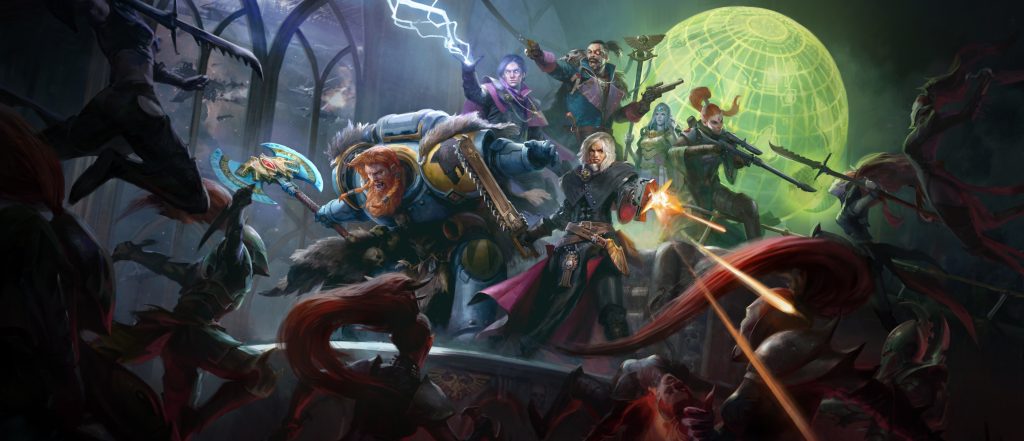
The art style in the game itself is alright, and serves it’s purpose but the actual drawn art, that make up a lot of the story, such as character portraits or still shots of certain scenes are amazing, there is so much great art in this game, and the music throughout the entire game is similarly amazing, with my highlight being the astropathic choir’s track in the Void Shadow DLC.
The game’s decisions are impactful unlike many RPG’s, where your decisions not only affect your own story and combat sequences but also your companions individual stories, your playstyle and the world around you. It is truly a great game that should be definitely on the list of those who enjoyed other RPG’s like Baldurs Gate, Pathfinder, Pillars of Eternity, or Tyranny. Great Game.”
Now I’ll go into my more in depth thoughts about the game this will be a little more detailed in my praises and my criticisms of Rogue Trader.
Narrative
One of the most important parts of any RPG is it’s narrative, not all great RPG’s have an amazing narrative, but none of them have a bad or non-existent one either. What makes narratives more important in RPG games than any other is that they are necessary for getting your player’s invested into the experience you’re trying to deliver. Typically, RPG’s don’t really have as high intense combat and their levels are a lot more sprawling and unfocused than other games. So to try and keep the player’s attention and interest, the narrative is often coupled to many other elements in the game. Rogue Trader like some RPG’s, has you play as a pseudo defined character along the lines of a Geralt of Rivia or Commander Shepard. You’re character already has a predefined role in the world, you don’t necessarily start from being a literal nobody like in a game such as Skyrim. These types of player characters are great for more structured narrative RPG’s, as it empowers the player to make their own decisions that will impact their individual experience. It also enables the writers to structure and create narratives that are more interesting and detailed on account of the writers being able to understand the players role in the world.
In a game like Skyrim the player can take on a large amount of roles, yes they are a “Dragon Born”, but that doesn’t really have a role within the world, you are not awarded any special privilege or social power on account of being “Dragon Born”. Skyrim opts instead to have their plots condensed into these questlines spread throughout the world that are completely uncoupled from the player’s role. In other words these questlines have nothing to do about being a Dragon Born. Or that because you are Dragon Born you are being pulled into these situations. It is a far more open ended experience where the player is really empowered to be whoever they want. We can think of a game like that sort of like a roller coaster park, fun experiences spread throughout a defined space, where the only limit is that you must meet some minimum criteria. You don’t have to experience everything and you are empowered to create your own unique experience playing the game.
Games like Rogue Trader, Mass Effect, The Witcher, link each experience back to your role within the world. The easiest example here is the Witcher, a monster hunter and so pretty much every major quest falls back to your role of killing monsters, whether they be human or inhuman. Your role within the world is well defined and so it’s easier to know how and what to write for a character like that, with the real challenge coming in what the player controls, the character’s personality. Are they cruel? Are they compassionate? Are they more a more neutral centrist? By shrinking that possibility space of who that character is coming into a story it allows writers to create a story that is more believable, focused and fun. It also allows for the other characters in the story to have a more believable relationship to the character you play. Which is also why many of these games have romance options in the first place and while I’m not going to talk about the romance in this game, mostly because I ended up a lonely bastard, it is worth mentioning that this game is more similar to a Mass Effect in it’s romance system.
Alright story time over, well, not quite. You know what I meant, back to Rogue Trader.
After making your character you begin the game on the flagship of Theodora von Valancius, your newly discovered relative who has called you up from whatever you were doing before to attend her, as you have been revealed as one of the potential heirs to the Von Valancius house. You meet Theodora’s Spy Master Kunrad Voigtvir and right away from with the very first dialogue option is one of the strongest points in this game’s narrative.
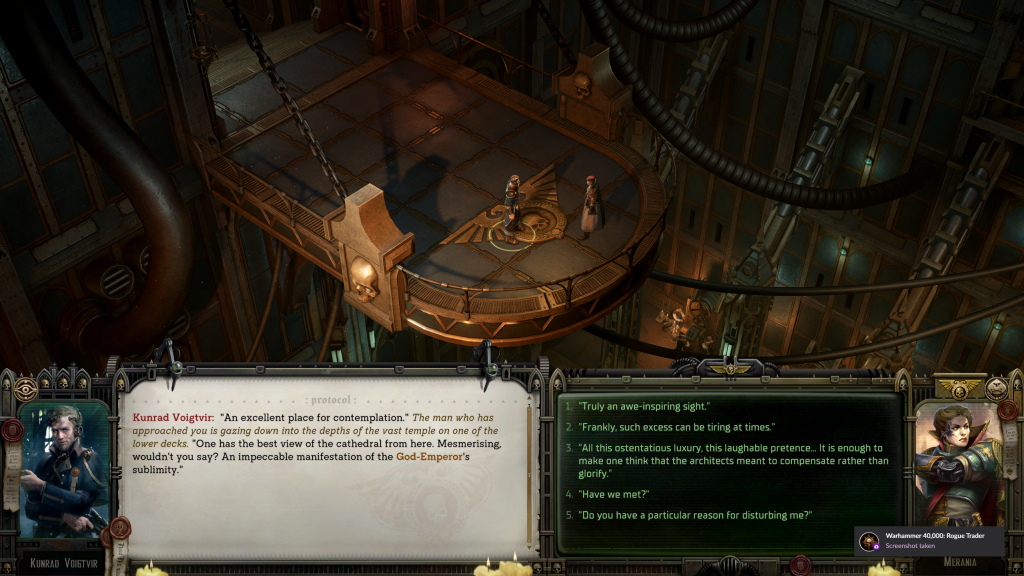
After being ambushed by lobotomized servants, you find lady Theodora and her other heir, where, again you are attacked by heretics who are staging a mutiny. You and Voigtvir are then dispatched by Theodora to a key area of the ship in order to not let the ship fall to the mutineers. When you set off and end up alone with Voigtvir, he reveals himself as the mastermind behind the mutiny and knocks you unconscious. You’re taken away to the heart of the ship, the Warrant Chamber where within lays an ancient relic, the Warrant of Trade, a written declaration by the Master of Mankind that endows the Rogue Trader with certain powers unique only to them for the sake of expanding mankind’s reach and influence in the galaxy.
Kunrad intends to break into the chamber using your blood to bypass the genetic lock on the door. After doing so you beseech the warrant guardian to protect you allowing yourself to break free from Kunrad’s grip and join up with Theodora’s Seneschal Abelard Werserian. With Abelard’s help you join up with other members of Theodora’s retinue an Unsanctioned Psyker, Idira Tlass who has a gift for prognostication and Sister Argenta, a member of the Adeptus Soriatas or the Sisters of Battle. Together you find that Theodora has been murdered in cold blood by an unknown individual, presumably Voigtvir and that you must get regain control of the bridge so that you can navigate the ship to safety before it’s destroyed by the mutineers.
Once you face Kunrad again and retake the ship’s bridge you alone now remain as the sole heir to the Von Valancius dynasty and thus you rise to your new station, Rogue Trader, and embark on your journey to save the Koronus Expanese. A small corner of the galaxy cut off from the rest of mankind’s sprawling empire, the Imperium, by a massive galactic storm called the Maw.
I won’t say too much more as I don’t want to spoil any other part of the story. What I will say is that I think the strongest narrative segments of the game are the opening and the First Act. I think they do an excellent job of establishing characters and having a well defined narrative arc for the player to experience, whilst still allowing the player plenty of freedom to make meaningful choices. That doesn’t mean that I think the second, third and fourth act are bad by any means, I still think they do a decent job relative to other RPG’s but I just feel that the first act does a masterful job at immersing the player in the world, in the characters and the overarching plot.
The other thing I would mention is that this is a very character driven story, the plot centers around certain characters in every act and your interactions both with these characters and your companions determines the overall direction and ultimately the conclusion of the story being told. Essentially, watch what you say and to whom.
On the topic of companions let me say that I really enjoy the companions stories in this game. It’s typical for these kinds of character driven stories that have you make a party of allies to also have companion story arcs, ala Mass Effect, Dragon Age, DOS 2, Baldur’s Gate, etc. The intention of these side plots is to give the player the impression that the characters in their party aren’t just mindless chess pieces you use in combat. But that these characters are individuals with their own motivations, on their own journey and you just happen to be a part of that story, or in some cases a major focal point of their story. I will not spoil or even describe tangentially what I like about these side plots, because honestly these are the real highlights of the game’s narrative and they should be experienced firsthand. All I will say, mostly because the game doesn’t tell you this directly is that the outcomes of these stories is very dependent on your relationship with these characters. So watch what you say to them or else. It should also be mentioned that you can entirely miss companions if you don’t pay attention, or say something to them they don’t really like, or if your alignment differs from them. I say this because the game also doesn’t mention this and I had this happen to me a few times in my first playthrough.
Another aspect I haven’t yet touched on yet is the one-off stories, little side quests or events that just come up as you are travelling the Expanse, for example their may be some ancient wreck just wandering through space that is begging you to explore it. Or as you are surveying a planet, you might stumble upon a random location which you can visit and see what the hell is going on. These little stories are also really fun to experience and for those that pay attention they also might offer some insight and indicators for where the story is going. It’s definitely not required reading though, nor are most of the other side quests.
I really enjoy the narrative not because I think it’s a really strong story and that it must be experienced, but because it offers the player a lot of freedom in determining who they are. You can be the faithful puritan burning and destroying heresy and corruption wherever you see it, regardless of the consequences. You could be a classical good guy, showing mercy and kindness to your foes, even when they don’t deserve it. You could be a greedy merchant, always willing to let things slide for the right price. Or you can just simply be a horribly evil bastard, killing and ruining lives for the glory of the dark gods. It’s honestly incredible how much attention to detail there is in the writing. As I discussed before, the narrative possibility space is shrunk on account of your character having a predefined role. But the writers and designers willingly expanded that possibility space to give players a lot more freedom in deciding who their character is. There’s definitely a world in which this game does allow you to be bad but it doesn’t allow you to be evil, or it allows you to be religious but not uber religious. Stories are already hard to write, but RPG stories are 10x harder to write, because you’re not just telling a story with a character with 1 type of morality you’ve got to tell the story for each of these alignments and make each of them satisfying in some way, so that the player is allowed to make the experiences feel truly theirs. Rogue Trader does that really well, better than 90% of RPG’s I would even venture, it’s emphasis on player choice is unlike many other games.
It isn’t always perfect though, I did, like in other RPG’s, find myself at times be annoyed with the dialogue options presented, because I thought there should have been an option that wasn’t there or I was lost because I didn’t really understand the options presented. These moments however annoying, are thankfully few and far between and as such in a game like this, that’s pretty damn amazing that it only happens a few times.
Lastly, before I get into the weeds with the gameplay I’d like to briefly breakdown the ending of the game, spoiler free of course, I just think it’s important to mention. I think the narrative progression and pacing of the game is very well done up to the 4th and final act of the game, I wouldn’t go as far to say that they ruined the ending, or that it was unsatisfying. I would say however that the pacing of the end of the third act and then the pacing of the entire 4th act felt very off. I definitely feel like the game was rushing to the end even though I think there could have been moments in the fourth act that could have allowed you to explore certain characters more. But whether it was deadlines, budget, gameplay limitations, etc. I think the 4th act is the weakest of the game. However, like I said this doesn’t make the game bad or the ending unsatisfying, I just think that they could have done a lot better in this section of the game.
Gameplay
To start this section off I think I should first Identify what I believe the gameplay loop of Rogue Trader is:
Visit different system -> explore system -> fight in space combat -> get loot/experience to upgrade your ship and ship’s abilities -> visit planets -> explore planets with your party -> fight enemies -> get loot and experience -> complete quests on planet -> upgrade your companions and equip them with stronger items -> talk with NPC’s / companions -> Visit different system.

There is of course more gameplay systems which we’ll discuss in detail but generally this is how the game looks.
This section of the review is dedicated to answering that one key question: Is the game any good? Yes, absolutely the combat and overall gameplay of Rogue Trader is a ton of fun and much like the narrative, gives players a ton of freedom to make their characters and companions look, feel and play unique. Rogue Trader’s combat is very DnD like, which is to say that it’s a turn based strategy system where characters are put into an initiative order based on their Agility stat. You then follow the initiative order one at a time, with each character being able to take a certain amount of actions when it’s their turn. The action’s a character is able to take is dependent on 2 factors, what items does the character have equipped and what that characters archetype is. All of the playable characters that you control all have archetypes, think of these as characters classes with the fun twist being that at later levels your characters will have multiple archetypes. You’ll use these multiple archetypes to augment your characters’ roles within combat. I don’t really want to go into the archetype system too in depth here. There will be a section later on, entirely dedicated to archetypes, because I think it’s a really great system and I got a lot to say about it.
The combat system can be pretty punishing if you don’t understand a few key principles, firstly positioning this is a key aspect to many turn based strategy games and no different here. Allowing the enemy to surround your characters gives them bonuses to hit the surrounded character but that mechanic also function vice-versa. So if you surround an enemy with a lot of friendly units you get a bonus to hit the enemy in melee. You might also want to position your stronger melee characters where enemies can’t run by you and attack your ranged characters. By blocking choke points, the enemy can’t run outside of your melee range or it risks triggering an attack of opportunity. Melee positioning is also important for inflicting a lot of damage, as you set up your character in a position where they can attack a lot of enemies at once with an sweep attack.
The same logic applies to ranged characters the game has an X-Com like cover mechanic that reduces your chance to hit enemies or the chance that enemies hit you. By positioning your characters correctly you can take away enemy cover or negate it by being at a higher elevation than your enemy. Another important reason to consider positioning is that characters with projectile weapons can cause over-penetration if they break through their targets armor. this means that the projectile will then continue through your target and into anyone behind your target, causing a smaller amount of damage. But this can be helpful when you’re dealing with a lot of smaller weaker enemies that you want to try to take down all at once. Ranged characters also have area attacks, melta and flamethrowers are by default area attacks and can harm a lot of targets all at once. Plasma weapons can be overcharged, meaning there’s a risk of the gun damaging your character in order to perform an area attack. Some projectile weapons can be burst fired meaning you perform a ranged area attack, at the cost of accuracy and ammo.
The other important focus of pretty much every Turn based strategy games is target prioritization. Usually the game will mix up different enemy types, mini-bosses, bosses, static turrets, etc., into a single combat encounter. The challenge is then you have to decide what enemy to focus on, in some encounters the solution is to get rid of the more powerful enemy first and then wipe out the rest. In other situations like a boss battle, you should deal with the low tier enemies first, then take on the boss directly. Target prioritization tries to get the player to work out combat encounters like a puzzle using the characters they have on hand to deal with the current situation.
The game does a good job of keeping up a mixture of both melee, ranged, powerful and weak enemies. Similarly, I think being able to understand what kind of targets you should be focusing on is very easy as there is, for the most part, a good visual and mechanical distinction between enemies. Even though you might not have fought this particular enemy before you know it’s powerful and kind of know what it’s capable of from it’s name, the weapons it’s carrying and a cursory look at it’s stats. The one area I think the game is lacking in is being able to convey quickly to a player what the enemy can do, as I just said you can see what the enemy is capable of, only after opening up their stat sheet and digging through the abilities section. But If there was a more streamlined screen or UI element, that you could quickly parse just by clicking on their character and if need be open up tooltips to give you a better description of the ability or skill that that enemy has.
I also found myself at time wishing for another QOL feature that I believe X-Com has, which is being able to plan out your characters movement and see that if from this new position you’d be able to hit a certain enemy with a certain ability. This feature only really concerns and is designed for ranged units, though this would come up if you wanted to see if your melee character was able a unit from their new position. I had a few frustrating moments with the combat where often time it was difficult for me to know that If I had moved my character to a new position would they be able to hit X enemy from there with a shorter ranged ability. The game only allows you to see what enemies will be in your line of sight. And since there is no real system that allows for this it’s a bit of a struggle on some of the more complicated levels, to perform a more complex maneuver.
A character’s equipment is also key to their combat prowess as there are certain items and weapons that can really change how you use your character in combat. For instance, there is a trinket that enables the wearer to never miss as long as their attack is a single shot ranged attack. Once I found this trinket, I began to adapt one of my party members builds around this playstyle of focusing on one target at a time. She quickly became my most broken party member, as at about the halfway point in the game she could deal an absurd amount of damage, even on bosses. But that’s just one of many examples of how the equipment you find in the game can sort of push you to make your character a certain build or support the build that you really want to have. A character’s equipment is just as integral to how you want your character to be used in both combat, narratively, and when exploring. And there’s a good variety of equipment that encompasses a lot of different playstyles, I do think that there maybe isn’t as much as there should be that is alignment locked. These items requires that the character equipping them to be of a certain alignment in order to use, like if you want to use the freaky amulet that’s imbued with demon magic, you kind of got to be evil motherfucker.
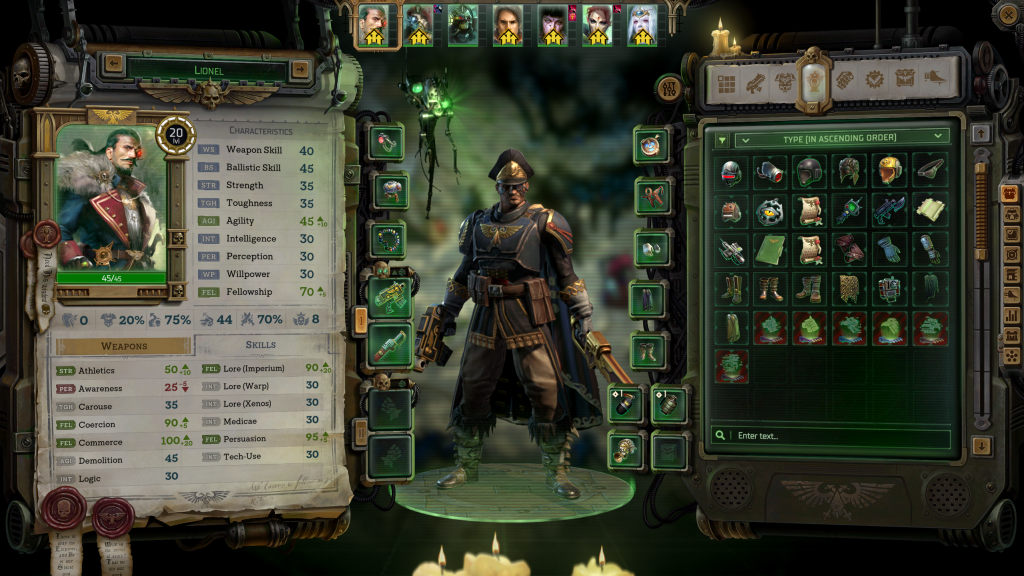
I’d even expand that to say that I wish there were more benefits and downsides to being of a certain alignment. There are plenty of narrative changes and visuals changes when you align yourself to either being very religious or being sworn to the dark gods. And it’s not that you don’t receive some buffs and debuffs. But I wish that your alignment perhaps unlocked some traits and abilities that you couldn’t have unlocked prior to obtaining a certain level within your alignment path. For instance, an officer ability where you inspire other humans in your party by saying a sermon to the God Emperor, giving them some temporary wounds, or maybe a damage boost against nonhumans and heretics. And there’s an alternate ability for being aligned with Chaos, you instead shriek forbidden words and it causes your enemies to be debuffed in some way, as your words leech away at their sanity. I think it might be an interesting way much like the other gameplay systems to couple the narrative and the gameplay together.
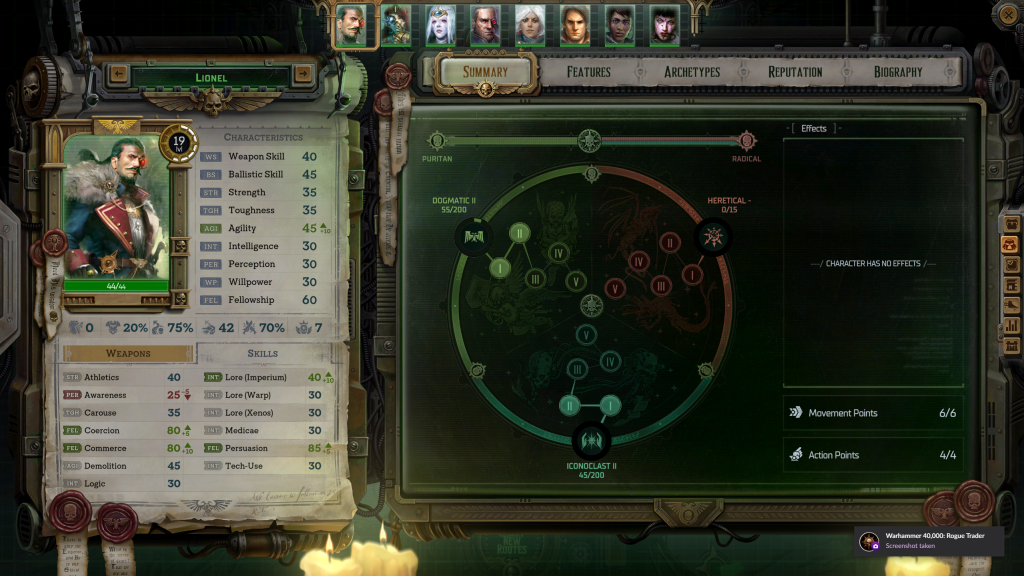
Skill checks are another unique aspect to many RPG games, throughout the game there will be a variety of tasks, dialogues, items, etc. that require certain skill levels. For example, in order to equip the heavy bolter the character that’s equipping it needs to have a pretty high strength stat. These kinds of skill checks are not dynamic, meaning they don’t require any RNG, you don’t roll an imaginary dice to figure out if you equip the heavy bolter. These are static skill checks, that simply require you to have enough points spent into a certain skill in order to use that piece of equipment. Dynamic skill checks means that the game generates a random number and based off your skill determines whether that random number falls within the success range. The success range is dependent on your own ability score factoring in the difficulty modifier on the check itself. If your number happens to fall within the success range you pass the check and any benefits that comes with passing the check. In dialogue, passing a skill check allows you to select a dialogue option that otherwise might not have been there should you have failed that skill check. When exploring, passing a perception skill check might alert you to hidden dangers or allow you to see minefield or other trap up ahead and defuse them before they go off. I enjoy these skill checks because it allows them to be used in a variety of places like exploring the world, dialogue choices, unlocking doors, bypassing certain segments of the game. Weaving this mechanic into both the story and the game allow for this system to act sort of like a link between the player and the narrative. As the player levels their character up and increases certain stats or unlocks certain abilities, it also allows their character more options or power in the game and the story, which then immerses the player further, as their actions now have a more direct way of impacting their character’s story.
It’s important to note that same is true for your companions, when performing a skill check the game chooses a character from your party who is best prepared to deal with the skill check. For instance, if there is some debris blocking the way, the game will pick the strongest character from your party to try and attempt to lift that debris. I really like this system as it adds another spin to building a party, there were certain characters I couldn’t live without in my party, some for their combat potential and some for their skills and abilities to pass skill checks. It just adds another dimension when considering the composition of your party. It also relates back to that interconnectedness between the different gameplay systems, which I feel is a real strongpoint of this game’s design.
The other incredibly important part of an RPG’s gameplay is it’s exploration, to get a player really immersed in this virtual world you need to empower them to explore it and “Find the Fun.” In this respect, I think Rogue Trader falls a little flat, as the game has very few of these non curated experiences for better and worse. Most all of the combats you have in the game are a part of this story or that one. The only real exception is the warp anomalies that come from travelling to a new system that hasn’t been properly charted yet so the ship suffers from a demonic incursion. You are then tasked with killing the demons before they kill more people and spread terror throughout the ship. There are also some one off encounters that come from exploring random planets throughout the expanse, these one off’s do offer some challenge but these sections are scattered sporadically throughout the game. So it doesn’t happen frequently enough to warrant much praise from these sections.
Archetype
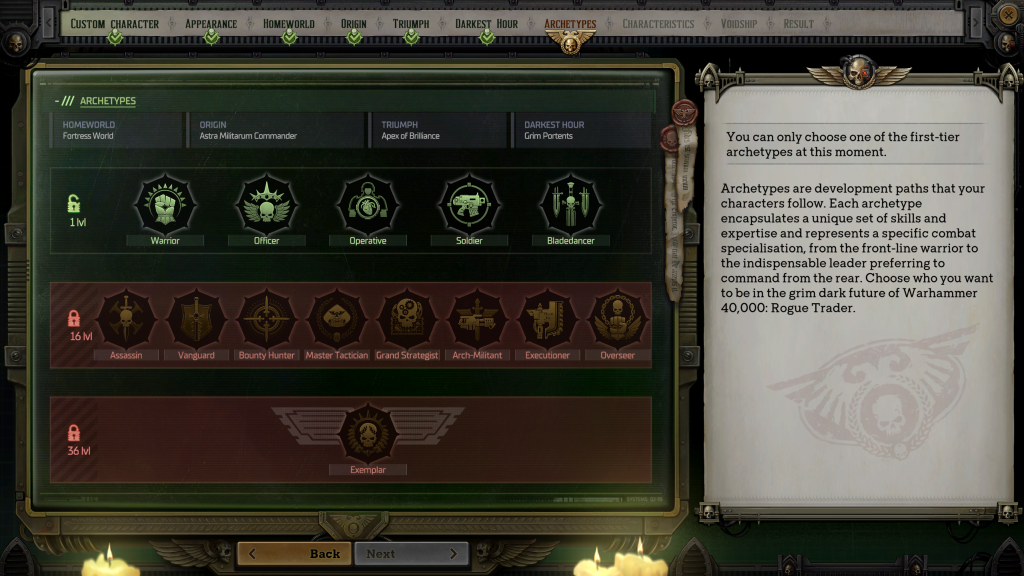
My favorite gameplay mechanic in this game is the archetype system, which functions in principle much like the DND class system. The archetype’s usually are focused on one or more core skills and have a range of abilities that you can unlock that use that core skill to scale the abilities power. You can also unlock talents that change the way your character can be used in combat. For instance, the soldier archetype has a talent that enables them to do more damage to the enemies depending on how they close they are to the soldier’s burst attack. This then changes how the player positions this character and utilizes this character in a firefight with a lot of enemies. Since very obviously you’d want the soldier to be positioned closer to the weaker enemies so that you can perform your burst attack and kill more of them.
However unlike DND, the archetype system functionally requires you to multi class (kind of). It’s more like sub classing but the sub classes don’t really have much, if any, interoperability with other classes. Their may be one or 2 talents that distinctly require you to have an ability or talent in another archetype. So for the most part all of the archetypes are independent from one another. However, there is another addendum to this, in that once you have chosen your first archetype at the start of the game you are then limited to just 3 archetypes after that, and if you have the DLC’s than you get a few more options depending on your base archetype. For example, you can’t choose an officer archetype and then chose a Assassin archetype later on. You can only take Grand Strategist, Master Tactician and Vanguard. The reason why you can’t take other archetypes is that they have different base skills and because of this you would be at a blatant disadvantage compared to other characters and enemies as you progress further and further into the game. By having archetypes that have the same base skills or utilize skills from your first archetype it allows all of your abilities and power to scale the way the game wants you to. However, the game makes up for hamstringing your power fantasy of the officer assassin combo, by giving you plenty of different playstyles for each archetype.
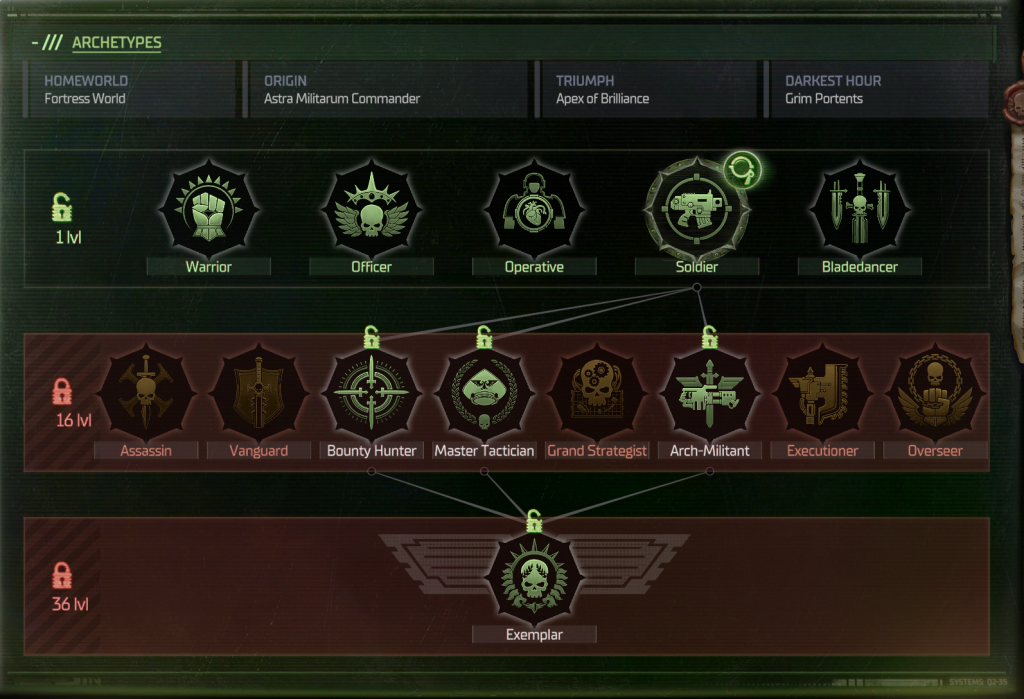
The reason I enjoy this system a lot is that it allows for freedom of expression by the player, to really adapt and have their own unique playstyle. Players are able to create their party that can feel and play distinct, even if you choose the same exact archetypes should you play the game again. There is such a wealth of talents to choose, changing how your character feels to play, skills that alter the characters playstyle and archetypes to change the character’s role within the party.
I think it’s a very well designed system that made progression feel very meaningful and gradual, every level was really important and I found myself late in the game refunding all of my characters’ levels so I could redo all of their talents and skills to get them to play exactly how I wanted to.
And after seeing some short gameplay snippets of Owlcat’s newest game Warhammer 40k Dark Heresy, I was very pleasantly surprised to see the archetype system still in the game and hopefully with even more archetypes or a whole array of completely new archetypes. I’m very interested in this game and hopefully we will see more at Gamescom towards the end of the month.
DLC
I want to start off this section by saying that the DLC of Rogue Trader is some of the best DLC I have played purely for the amount of content, side quests, new mechanics, areas, companions that all fit nicely into the base game. One of the hardest things to do in these kinds of RPG’s is to add new companions. Because not only do you have to write an entirely new character and try to fit them into the party. You then have to write completely new material for both the new companion and every other companion. Then you have to ensure that that new companion’s story and dialogue all fits and gels within the game’s story and that the story now accounts for the companion’s presence. It’s a pretty monumental task all on it’s own and an impossible one if you didn’t plan on having another character in the player’s roster in the first place. Which is why most of the time this kind of content is planned well in advance. I’d even venture that they were planning these new companions when they were making the base game companions, to ensure that when this content eventually came out that their was a place in the story for them.
The newer content like being able to travel to different parts of the ship in the Void Shadows DLC, is a much needed addition to the game. As without it it’s hard for the player to imagine that this ship is essentially this city in the void. The Lex Imperialis DLC, is a little more lacking in this area as it feels more like a standard RPG DLC expansion where the developers create this entirely new area that is independent from the base game content. On top of that the only addition to the standard gameplay that this DLC grants, is that it creates a new archetype that focuses on you having a companion and buffing them and yourself.
The Void Shadows DLC is a real highlight with you being able to interact more with crew members the aforementioned new sections of the ship you can travel to. These all lead to enhancing the setting and deepening the player’s attachment to their crew, the ship and the story. The companion in this DLC, Kibellah the Death Cultist, is also a good addition to the party with her abilities being fun to use, as she is a DPS melee character that really focuses on positioning, movement and timing. Also her companion story was very interesting to me, especially it’s conclusion, that’s all you’re getting out of me. The main enemy you face in this DLC is the insidious genestealer cult that has worked it’s way into the bowels of your ship, and has enslaved and enthralled a significant portion of your crew turning them into mutants that have their DNA spliced with Genestealers, a bio form of the Tyranids. An alien race that came from outside the galaxy to devour all organic life to sustain itself. The genestealers act as scouts preparing for the main fleets arrival by enslaving humans with their psychic powers, and altering their DNA to allow them to be more easily controlled. The cultists will then rebel and destabilize the local planet just in time for the the main Tyranid fleet to arrive and more easily consume the planet with little resistance. And now that threat is not only on your ship, but it is also mysteriously spread throughout the expanse, the DLC’s story focuses on you finding and stopping this threat before it spreads any further. Also as a final sidenote the Astropathic choir’s theme in this DLC is my favorite track in the entire game. It is somberly beautiful.
What I really don’t like however with both this game and many others, is the “Season Pass” concept. To be blatantly honest Season Passes are a bullshit concept that relies on the consumer to invest into a string of future DLC’s or “Seasons.” In these season passes developers often provide assurances along the lines of “2 new DLC expansions, 4 new skin packs, 5 new weapons.” That’s where I find fault in this concept, with these assurances, the consumer is under the pretense that those DLC’s WILL happen, they WILL get those skins and they WILL unlock those weapons. However the developer and any reasonable individual knows that at any point in time, plans may change, or a shift in vision may occur and now the company must pivot in a different direction. Or in extreme cases, the company may go defunct, or if the company is a subsidiary of a larger company that then is bought up by a different company, point being shit happens. And despite all of that, their are assurances given to the consumer with no recourse or avenue for the consumer to try and recoup their losses on their “investment.”
And while I have do not know of any hard concrete examples of this, it’s not that hard to imagine this situation occurring. I understand why developers do this, it’s an indicator to them to see if people are interested in new content in the game. It’s also a way of insuring that you make just a little bit more money, if you have people pay for the new DLC’s and all of the bonus content together in a single season pass. They might pay a little more for that, rather than buying everything separately. Especially where it’s more likely those individuals would pay for the DLC’s with actual content as opposed to just the skins, especially in an RPG game. If you were to juxtapose this with the battle pass structure of a Fortnite or Apex Legends, the difference is clear and obvious, it’s transparency. The battle pass in those games will let you freely look at a lot of the skins to make you want to get the battle pass. But you get to see all of the content and cool things you’ll receive straight up. Whereas these season pass investments obfuscate so much, so as to draw up intrigue in the consumer and then they riddle the season pass assurances with buzz words to draw up hype and make you want to buy it. The lack of transparency with these season pass DLC’s makes me very worried that they will or are being abused to fuck over consumers. I hate it, please stop, just go back to the “Game of the Year” edition format.
Conclusion
As I’m finally wrapping up this review I want to finish up by mentioning some other really good stuff about this game. Firstly the visuals, overall I think the visuals are serviceable, some of the in game models are very well made and highly detailed like the Forge Fiend and other larger monsters. But my favorite aspect of the visuals is the key art, the art in this game is just awesome, I mean just look at it:
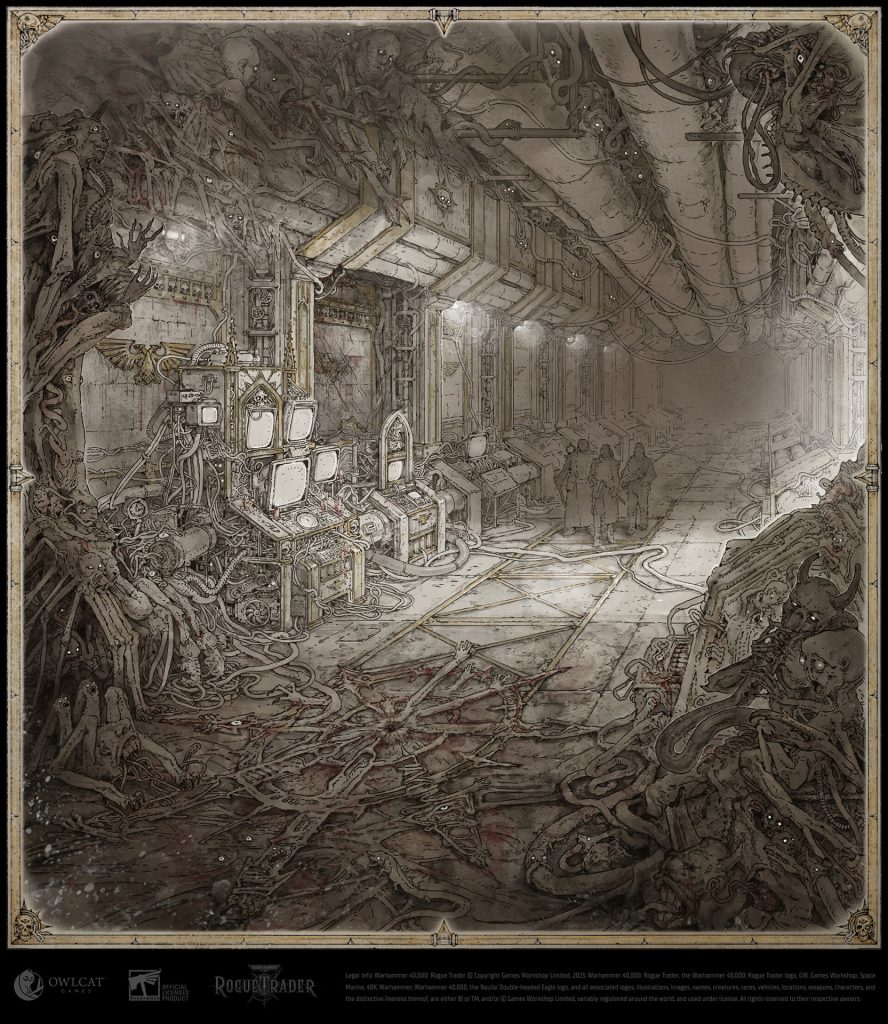

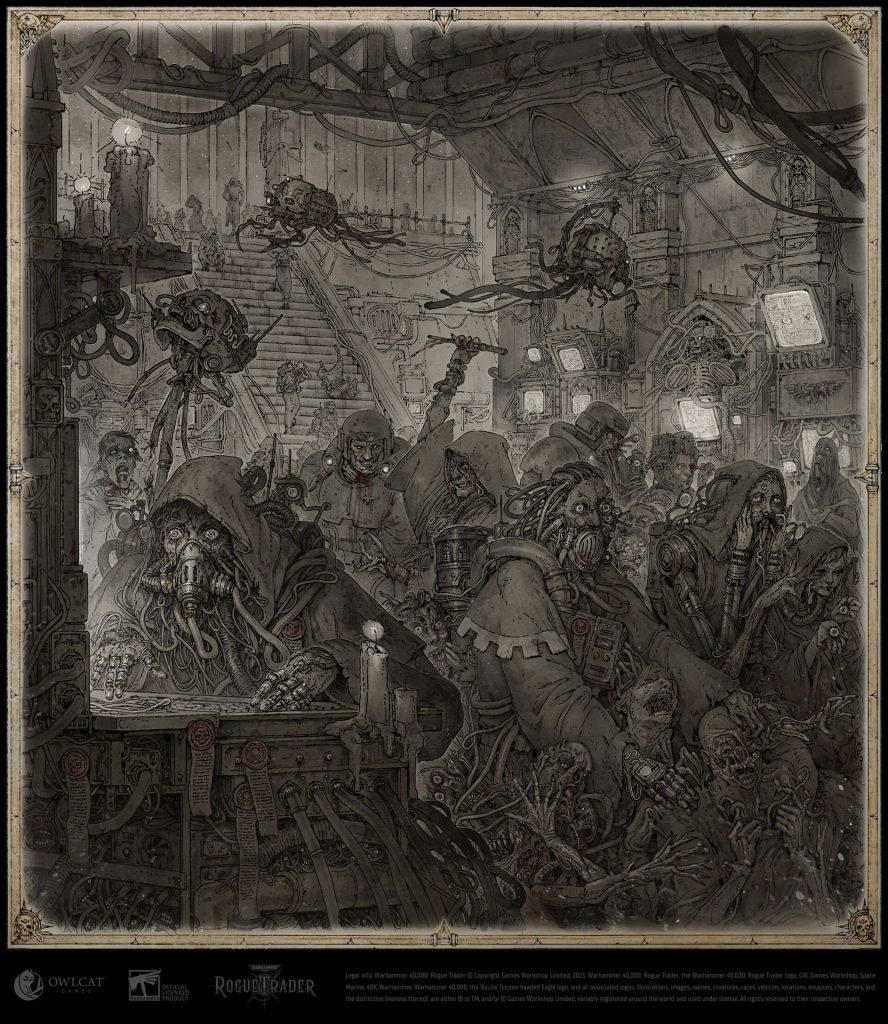
I love the visual stories that the key art is trying to tell, that coincide with the story in the game. These produce some really cool moments where the perspective of the story shifts from your first person perspective and to another’s, or maybe a third person perspective that’s structured like an after action report, or a folk-tale, these moments are just great.
The other smaller thing I’d like to mention is the voice acting, it’s really prominent in the prologue and first act and then it just sort of stops, besides certain moments and conversations with your companions. But when it is there, the voice acting is really well done as each actor really gives their all to bring a lot of personality to their character. Which is why it made me pretty sad when it went away, even though I knew there was no way they would be able to keep that up throughout the entire game.
So what is the final consensus on Warhammer 40k Rogue Trader? I don’t like a numerical rating system with games because I honestly think it’s a little cheap and does a disservice to the developers and fans. I instead use the patented rating system from one Scott Robinson AKA “Mr. Sark” of Machinima Respawn fame, the “If You Like…” system. I think it goes without saying if you’re a fan of Warhammer 40k this game is a must play, majorly because this game has a lot of depictions about the setting and the lore that I found really interesting. If you like Pathfinder, Divinity Original Sin 2 or Baldurs Gate 3, I also think you would feel right at home in this game and really enjoy the characters, the lore and the gameplay. And if you liked a sci fi game like Mass Effect for it’s characters and lore, I think you’ll really enjoy this game.
It’s not often that I play an RPG and go “wow, that was amazing,” lots of RPG’s are typically long and give you a lot of time to mull over all the ways it’s not a great game. And I’m not saying Rogue Trader is one of the best RPG’s of all time, but it is pretty damn good and I thoroughly enjoyed my experience playing it. And I plan on playing it again once all the DLC comes out and I’m looking forward to Dark Heresy and the new detective system they have in that game.
Good Stuff.
P.S. I’m sorry this took so long, there was so much to write about and I could have written about. RPG’s just take a while. In any case, thankfully there’s no other RPG in the back log so the next reviews should come shortly. Next Up.. Dead Format. An indie survival horror.